
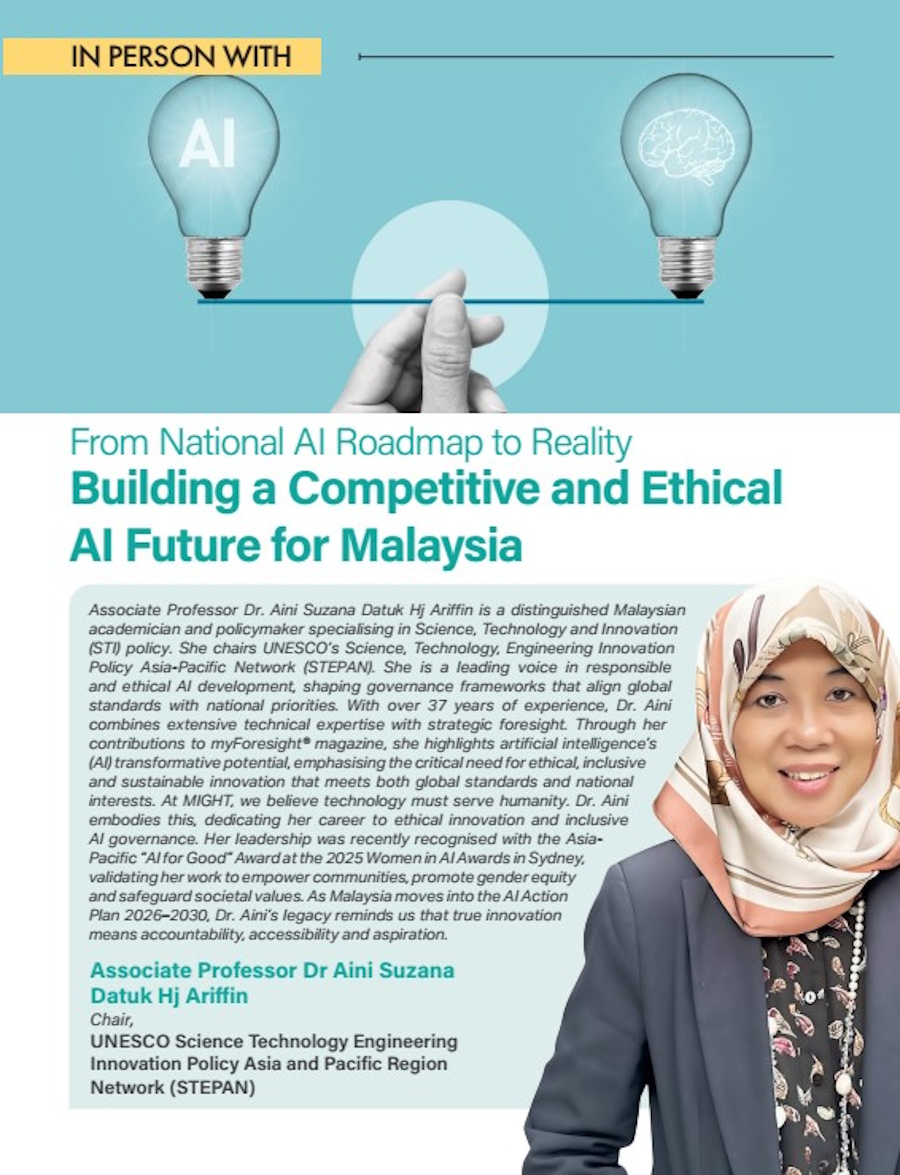
Artificial intelligence is rapidly reshaping economies, public services, and global competitiveness. As countries race to harness the transformative potential of AI, the challenge is no longer simply technological capability, it is governance. Nations must ensure that AI development is ethical, trustworthy, and aligned with societal values.
Malaysia has taken a proactive approach to this challenge. Through strategic policy initiatives, multi stakeholder collaboration, and international engagement, the country is building an AI ecosystem that balances innovation with responsible governance. Insights from Associate Professor Dr Aini Suzana Datuk Hj Ariffin, a leading expert in AI policy and ethics, highlight how Malaysia is progressing towards becoming a trusted AI hub in the region while maintaining a strong commitment to responsible AI development.
Malaysia’s National AI Roadmap: From Vision to Implementation
Malaysia’s AI journey accelerated with the launch of the National AI Roadmap 2021–2025, a national strategy designed to guide the development and adoption of AI technologies across the country.
The roadmap was developed through extensive collaboration involving government agencies, industry stakeholders, academic institutions, and civil society. This quadruple helix engagement model ensured that AI development would be both technologically robust and socially inclusive.
The roadmap focuses on several critical pillars, including:
• governance and responsible AI ethics
• research, development and commercialisation
• talent development and workforce reskilling
• digital infrastructure and data management
• societal engagement and public awareness
Implementation has progressed significantly. Approximately 70 to 75 percent of the roadmap’s initiatives have already been achieved, reflecting strong coordination among ministries, research institutions, and industry partners.
This progress has been supported by multiple national institutions, including the Ministry of Science, Technology and Innovation (MOSTI), the Malaysian Research Accelerator for Technology and Innovation (MRANTI), and the Malaysia Digital Economy Corporation (MDEC). Together they have helped build a growing AI ecosystem that integrates policy, research, and industrial adoption.
Building a Responsible AI Governance Framework
Technological capability alone is not enough to ensure sustainable AI adoption. Trust is essential.
Malaysia’s approach emphasises responsible AI governance, guided by the national AI Governance and Ethics Guidelines (AIGE) framework. These guidelines apply to policymakers, developers, regulators, technology providers, and end users, promoting responsible use across the entire AI ecosystem.
The framework is anchored on seven core principles:
• fairness
• safety
• transparency
• inclusivity
• accountability
• privacy
• human centric design
These principles align closely with the UNESCO Recommendation on the Ethics of Artificial Intelligence, ensuring that Malaysia’s governance framework reflects internationally recognised standards while also addressing national priorities and cultural contexts.
Beyond governance policies, Malaysia has also strengthened its legal and institutional framework to support responsible AI deployment. Updates to national cybersecurity legislation and data protection regulations aim to protect digital infrastructure, ensure responsible data use, and safeguard AI systems against emerging cyber threats.
Malaysia’s Growing Role in Global AI Governance
Malaysia’s AI strategy is not confined to national boundaries. The country is increasingly active in regional and global AI governance discussions.
At the international level, Malaysia participates in the development of global AI standards through the International Organization for Standardization (ISO). Malaysian experts have contributed to the development of more than 25 international AI standards, helping shape global norms around responsible AI development.
Regionally, Malaysia has also played an important role in shaping AI governance across Southeast Asia. The country contributed to the development of ASEAN AI guidelines and the ASEAN Responsible AI Roadmap 2030, initiatives aimed at harmonising AI governance across the region.
Malaysia’s international engagement extends further through collaborations with countries such as the United Kingdom, China, Australia, Japan, and South Korea. These partnerships focus on sharing expertise in AI regulation, standards development, and ethical governance frameworks.
Such cooperation strengthens Malaysia’s position as a responsible participant in the evolving global AI ecosystem.
Towards Malaysia’s AI Masterplan 2026–2030
Malaysia’s AI strategy is now entering its next phase. As the current roadmap approaches completion, policymakers are preparing the Malaysia AI Masterplan 2026–2030, which will guide the country’s future AI development.
The next stage will focus on several priorities:
• strengthening national AI infrastructure, including data centres and high performance computing capacity
• expanding AI talent development across universities and workforce training programmes
• encouraging responsible AI adoption across key sectors such as healthcare, education, finance, and smart cities
• strengthening international collaboration on AI governance and standards
Significant investments are already supporting this transition. Malaysia has attracted over US$21 billion in technology investments in recent years, including major investments in data centre infrastructure and AI technology development.
These investments strengthen the technological foundation needed to support advanced AI applications while reinforcing Malaysia’s ambition to become a regional hub for AI innovation.
A Human Centric Vision for AI
Malaysia’s AI strategy is ultimately grounded in a broader vision: ensuring that technological progress benefits society as a whole.
The country’s commitment to “AI for Good” emphasises inclusivity, ethical governance, and social responsibility. Initiatives aimed at improving AI literacy, promoting gender equity in technology, and encouraging grassroots digital participation are helping ensure that AI development remains accessible and beneficial to all segments of society.
This approach reflects a key principle in Malaysia’s AI journey, that technological advancement must be balanced with trust, transparency, and social impact.
“AI governance must be a living framework, adaptive, inclusive and deeply ethical.”
As Malaysia transitions towards its next AI development phase, the country’s experience offers a valuable example of how innovation and responsibility can progress together.
AI governance must be a living framework, adaptive, inclusive and deeply ethical.
Read the Full Article
About the Author
Associate Professor Dr Aini Suzana Datuk Hj Ariffin is a Malaysian academic and policymaker specialising in science, technology and innovation policy. She serves as Chair of the UNESCO Science Technology Engineering Innovation Policy Asia Pacific Network (STEPAN) and is widely recognised for her leadership in responsible AI governance and ethics. With more than 37 years of experience in research and policy development, she has played a key role in shaping Malaysia’s AI governance frameworks and promoting ethical AI development at both national and international levels.

Leave a Reply